



In a foundry, a lot is decided in the seconds after the die opens. The aluminium part has solidified, but it is still warm and therefore soft. That is exactly when a robot has to grip it, take it out of the machine and hand it over to the next station. Grip too hard or in the wrong place and you leave pressure marks or distort the part.
Then there is space. The gripper has to reach into machines and cells where every centimetre of height counts. In this article we describe why standard grippers reach their limits on warm castings, how an adaptive gripper solves the problem and why we rebuilt the MATRIX Flex Clamp for exactly this task: with half the height and half the weight.
The challenge: warm, soft and never exactly alike
Four things come together when handling castings:
- Temperature: Shortly after casting, aluminium has only part of its later strength. From the heat treatment of thin-walled structural parts it is known that at high temperatures even the part's own weight can cause permanent distortion. A gripping force applied at single points has a correspondingly stronger effect.
- Casting tolerances: No two castings are exactly alike. Shrinkage, distortion, the parting line, flash and gate remnants mean that the real contour deviates from the CAD contour. The permissible dimensional, form and position tolerances for castings are defined in ISO 8062-3. For the gripper this means a slightly different geometry in every cycle.
- Installation space: Removal points are tight. A gripper that builds too high does not reach the part at all. And every kilogram on the robot flange is missing from the payload.
- Part variety: A cell rarely runs just one part. Housings, covers, brackets and carriers alternate, and every new model series adds geometries.
Each point can be solved on its own. It gets difficult because all four apply at the same time.
The classic approach: finger grippers and part-specific jaws
Most cells use a finger gripper or a gripper with jaws milled for one specific part. Both have their place and their limits:
- Finger grippers: Compact, fast and proven. But they hold the part at a few contact points. Surface pressure is high there, and on a warm, soft casting it stays visible as a pressure mark.
- Form jaws: They spread the force over a larger area but only fit the nominal contour. If the part deviates because of casting tolerances, the jaw again touches at single points only.
- Less gripping force: Reduce the force until nothing is dented and the part is no longer held securely during fast robot movements.
- One set per variant: Every geometry needs its own jaws or its own gripper. That means gripper changes during changeover, a store of change parts and weeks of lead time when a new part starts.
In short: the classic gripper requires the part to fit the jaw. A casting never fully does, and when it is warm it does not forgive the difference.
The solution: the gripper takes the shape of the part
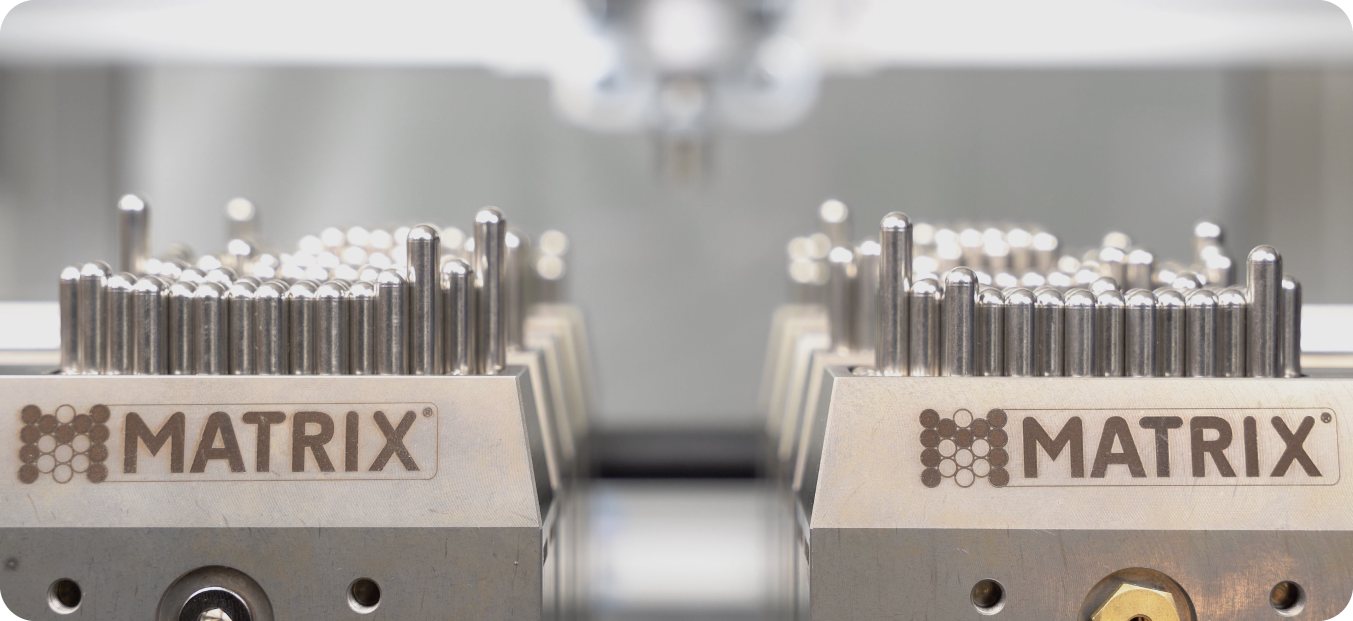
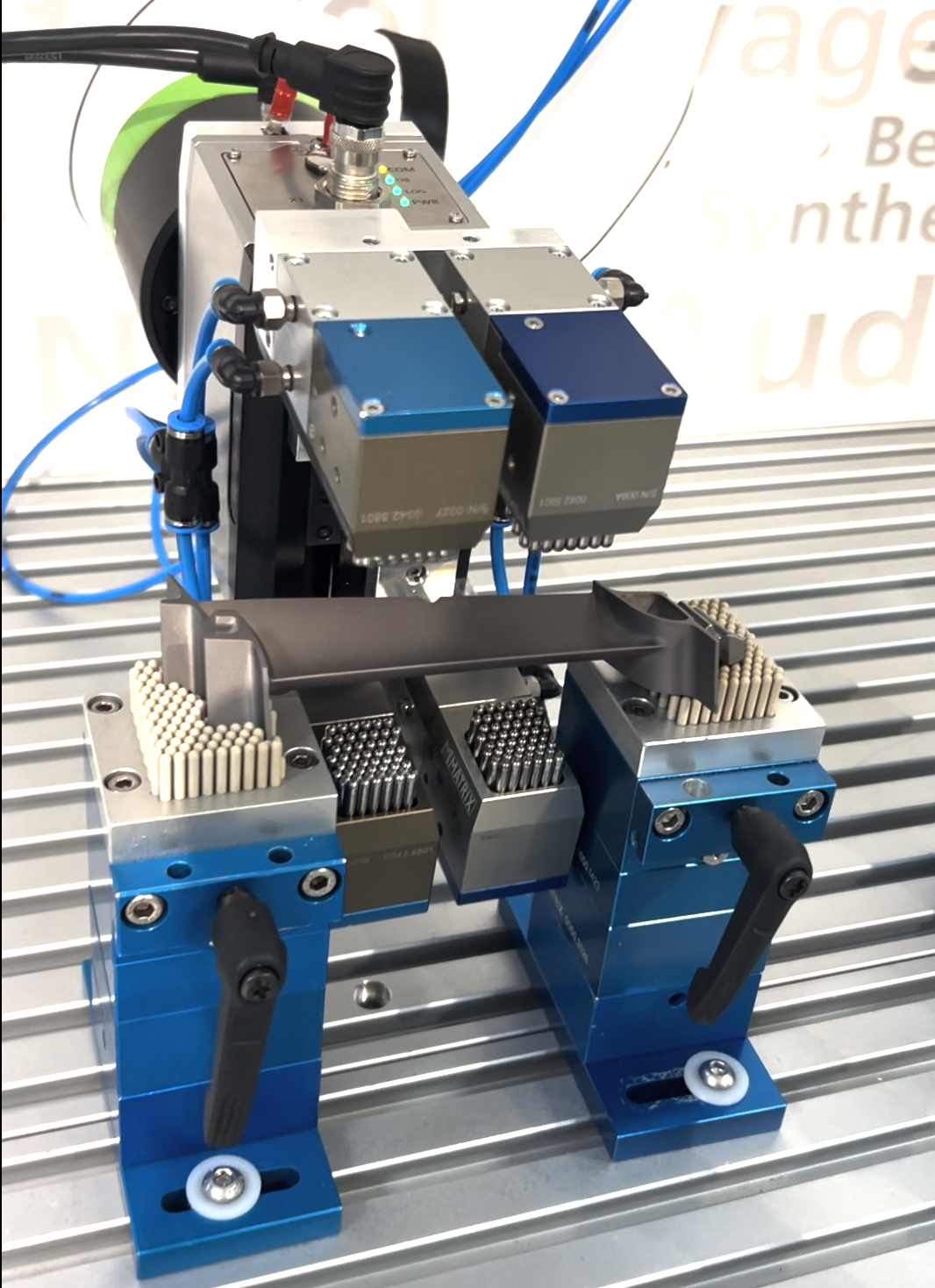
The MATRIX Flex Clamp turns this logic around. Instead of fixed jaws it works with a large number of individual pins. As the gripper closes, the pins conform to the real contour of the part and form its negative. Then they are locked. The gripping force is spread over many contact points, and the part is held by form fit instead of being clamped at single points.
Video: The new Flex Clamp grips a light bulb, a cast housing and an egg one after the other, without a changeover
The process in four steps
- Conform: The gripper moves to the casting. The pins adapt to the contour, including ribs, radii and free-form surfaces.
- Lock: The pins are fixed in position. The shape of the individual part is now stored in the gripper, including its tolerances.
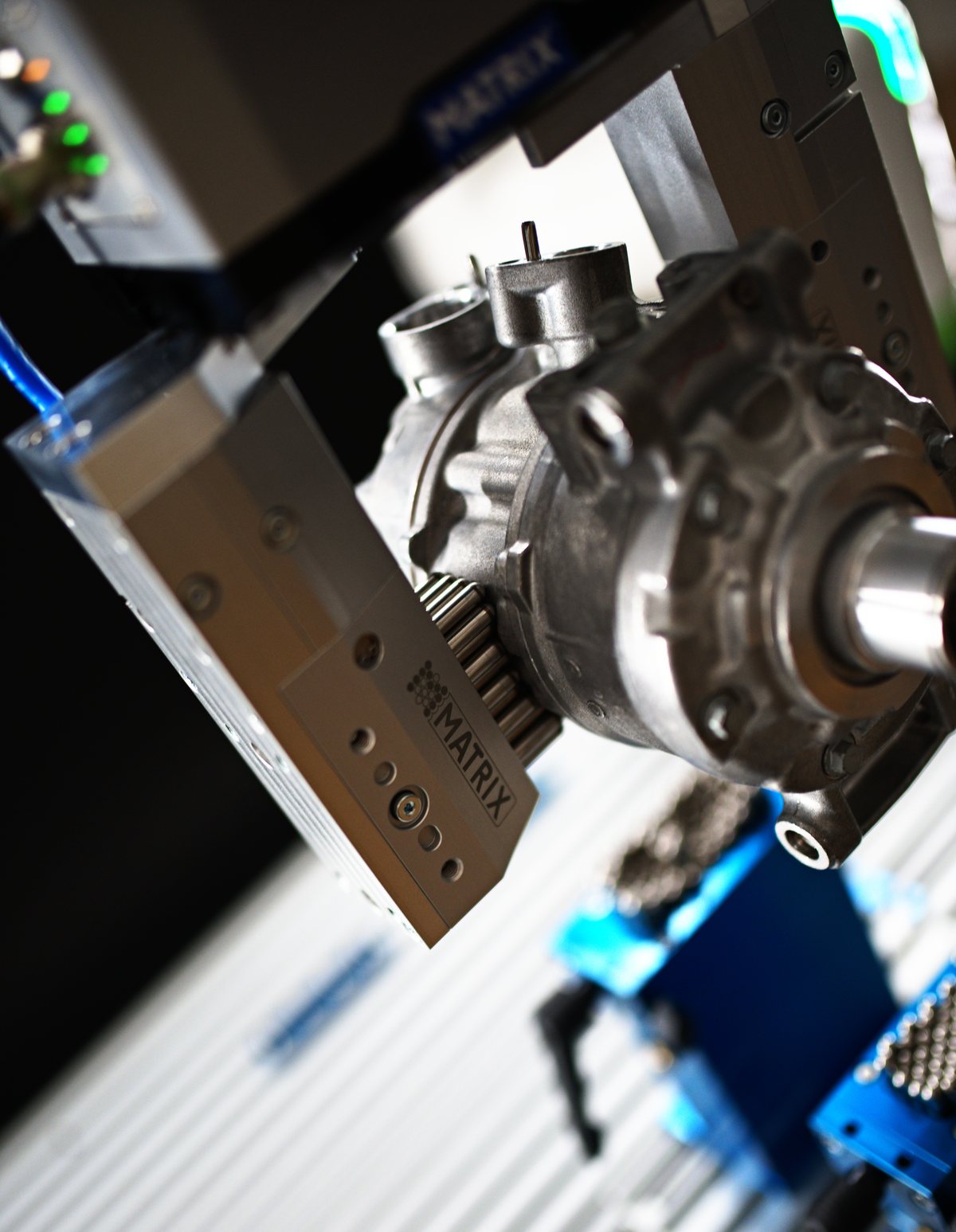
- Hold and remove: The robot takes the part out of the machine. The force is applied over an area, nothing is dented.
- Place and continue: The lock releases and the pins reset. On the next part the gripper conforms again, even if it is a different variant.

What is different about the new generation
The gripping principle is the same as in the previous Flex Clamp. What is new is the design:
- Half the height, with a larger gripping area
- Half the weight: less mass on the robot flange, more payload for the part
- Up to 10 kg per gripper pair: for heavier parts, several pairs can be combined on one gripper
- Fits into existing machines: machines and cells that an adaptive gripper could not physically enter before
To be fair: a finger gripper remains more compact. An adaptive gripper needs some installation space. With the height cut in half, that space is now available in many machines where it used to be missing.
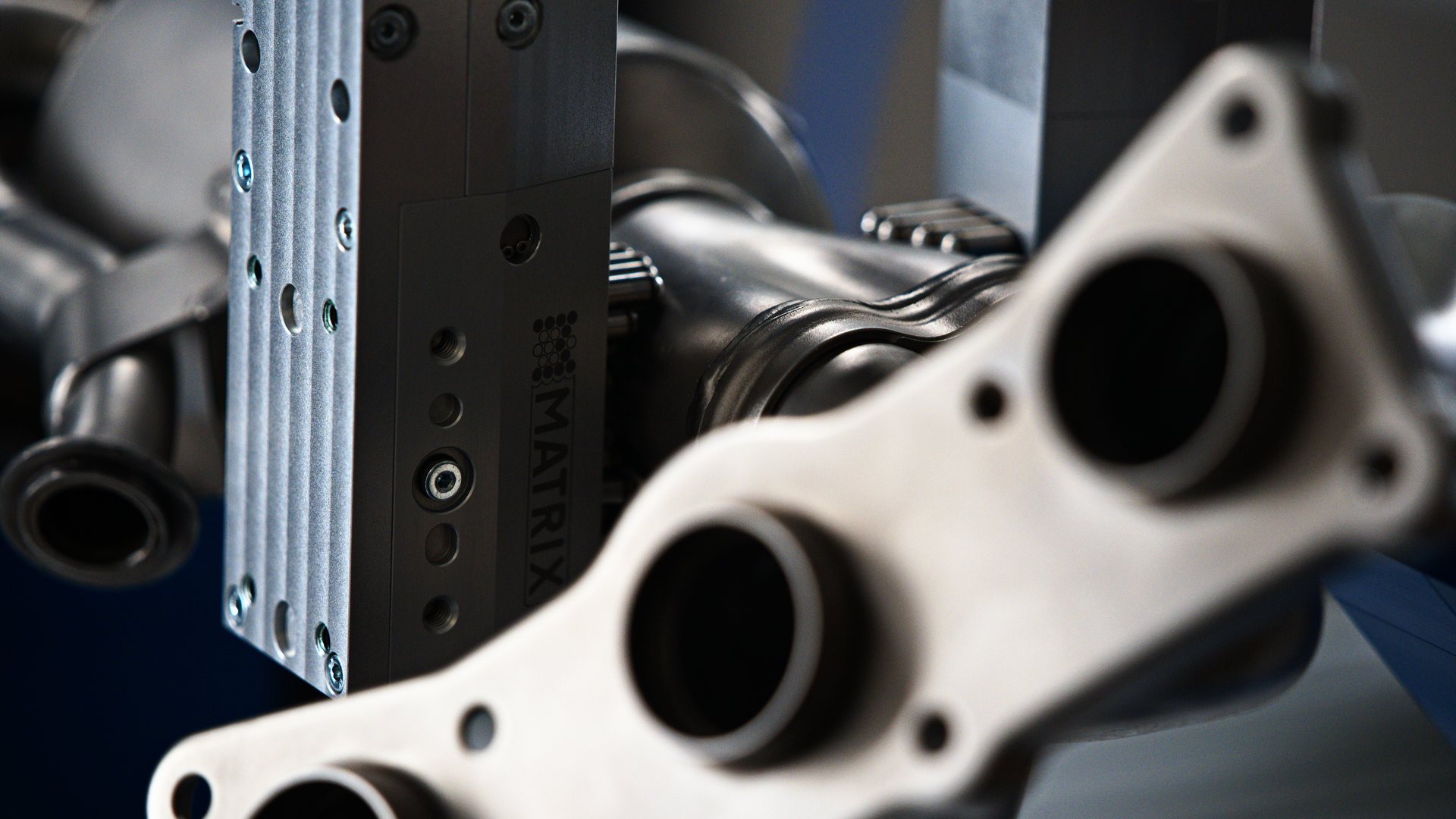
From practice: the case behind the new generation
The trigger came from an aluminium foundry. There, a robot removes castings while they are still warm. The standard gripper in use dented the parts. An adaptive gripper was the obvious solution, but our previous module was too large to fit into the machine.
With the new generation it fits. The pins conform to every single casting, absorb its tolerances and hold it without deforming it. The first grippers are already running in production, and more have been requested.
Use cases: where an adaptive gripper helps in the foundry
- Removing warm parts: taking castings out of tight machines before they have cooled down completely
- Handling between stations: transfer to cooling, deburring, blasting and inspection with the same gripper
- Mixed variants in one cell: different housings, covers and brackets without a gripper change
- Thin-walled and ribbed parts: structural parts and housings that react sensitively to point loads
- Heavier parts: several gripper pairs on one gripper when 10 kg per pair is not enough
The rule of thumb: the more sensitive the part, the larger the scatter in contour and the more frequent the variant change, the greater the leverage. For a robust part that runs unchanged in high volume for years, the finger gripper remains the more economical choice.
Business case: what one gripper for all variants saves
The economic effect can be estimated conservatively. The assumptions: one handling cell with 20 active casting variants, two to four variant changes per day, 240 production days, around 150,000 parts per year.
- No part-specific gripper jaws (20 variants × €2,000 to €4,000, spread over four years): approx. €10,000 to €20,000 per year
- Shorter changeover times (10 to 20 minutes per gripper change × 2 to 4 changes per day × 240 days, at around €125 per machine hour): approx. €10,000 to €40,000
- Less scrap and rework from pressure marks (0.5 to 1 % of parts at a part value of €15 to €25): approx. €10,000 to €35,000
- Less engineering for new variants (3 to 5 new parts per year × €3,000 to €5,000 for design, manufacture and testing of the jaws): approx. €10,000 to €25,000
→ Estimated total savings per cell and year: €40,000 to €120,000
Note: These are conservative guide values for a single cell. With several cells, a higher part value or more variant changes, the effect scales accordingly. Not included is the strategic leverage of bringing new castings into the cell without gripper lead time.
Why now is the right moment
- Castings are getting larger and thinner-walled. Structural castings and megacasting are shaping the industry, and megacasting was one of the big topics at EUROGUSS 2026 as well. The thinner the wall, the more sensitively the warm part reacts to the gripper.
- Part variety is increasing. Smaller batches and shorter model cycles mean more changeovers. Every gripper change costs machine time.
- Staff for hot workplaces are hard to find. Anyone who wants to automate removal and handling needs a gripper that copes with real castings and not just with the CAD model.
Conclusion: the casting does not have to fit the gripper
Warm castings are soft, vary in contour and sit in tight machines. A gripper with fixed jaws can only respond with more variants, more changes and more caution. An adaptive gripper takes the shape of every single part, spreads the force and absorbs casting tolerances. With half the height and half the weight, the new Flex Clamp now also fits where installation space used to be the obstacle.
For foundries this means: warm and cold parts, today's and future variants, one gripper, one process.
Your castings, our gripper
If you remove castings automatically or handle them between stations, talk to us. Send us a STEP file or a photo and tell us the weight, the temperature at the gripping point and the available installation space. We will usually tell you within a few days whether and how we can grip your part. Have your part checked