.svg)
.svg)

.png)
.png)

.svg)
.svg)
Automated and Flexible Clamping of Turbine Blades for the Measurement Process
Turbine blades are among the most complex components in aerospace and energy technology. Varying lengths, profile shapes, twists, root geometries, and coatings mean that hardly any two blades are identical. At the same time, these components must be safely gripped, fixed, and measured repeatedly throughout manufacturing and inspection processes.
Traditional clamping systems quickly reach their limits: Each new blade variant often requires a new fixture – both in handling and metrology. This drives up costs, extends changeover times, and complicates the setup of automated measurement cells.
MATRIX addresses this challenge with two building blocks:
MATRIX FlexCLAMP® – an adaptive clamping system for gripping and fixing changing blade geometries.
MATRIX FLEXSTATION® – a CAD-controlled platform for flexible measurement fixtures, e.g., for horizontal positioning of blades in tactile measurement processes.
Challenge: Variability and Complexity of Blade Geometries
Turbine blades – whether for aircraft engines or stationary gas turbines – are manufactured in numerous variants. The components differ in:
- Length and curvature of the airfoil
- Torsion and twist
- Root geometry (e.g., fir-tree profile)
- Surface coating and thermal barriers
- Manufacturing stage (raw part, pre-ground, finish-machined)
For manufacturing and inspection processes, this means:
- Repeated fixturing of the same blade in different process steps
- High demands for repeatability and component protection
- High variant diversity that is difficult to manage with rigid clamping systems
Traditional Clamping Concepts and Their Limitations
Traditionally, turbine blades are clamped using component-specific fixtures, such as:
- Prismatic clamping jaws
- V-blocks and special jaws
- Hardened form inserts for airfoil or root
- Dedicated measurement fixtures in the measurement cell
Typical consequences:
- High design and manufacturing effort for each new blade variant
- Large inventory of inspection tools and grippers – including storage and administrative overhead
- Changeover times for every geometry change (gripper change, measurement fixture change)
- Gripper warehouses, as separate jaws must be kept ready for each variant
- Risk of pressure marks or damage to sensitive airfoils and coatings
The broader the blade portfolio, the more workpiece handling itself becomes a limiting factor in measurement and inspection processes.
Handling Solution: Adaptive Clamping with MATRIX FlexCLAMP®
The FlexCLAMP system from MATRIX was developed precisely for this situation. It replaces rigid blade fixtures with an adaptive clamping system that automatically adjusts to different geometries.
Functional Principle
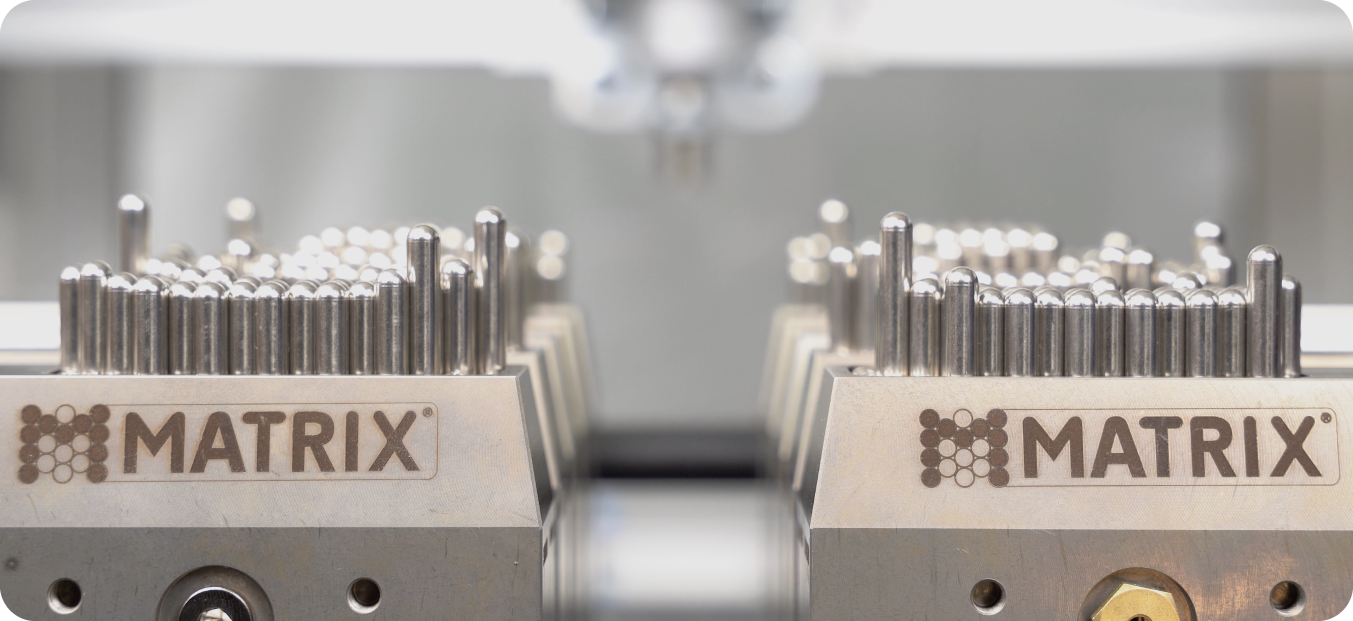
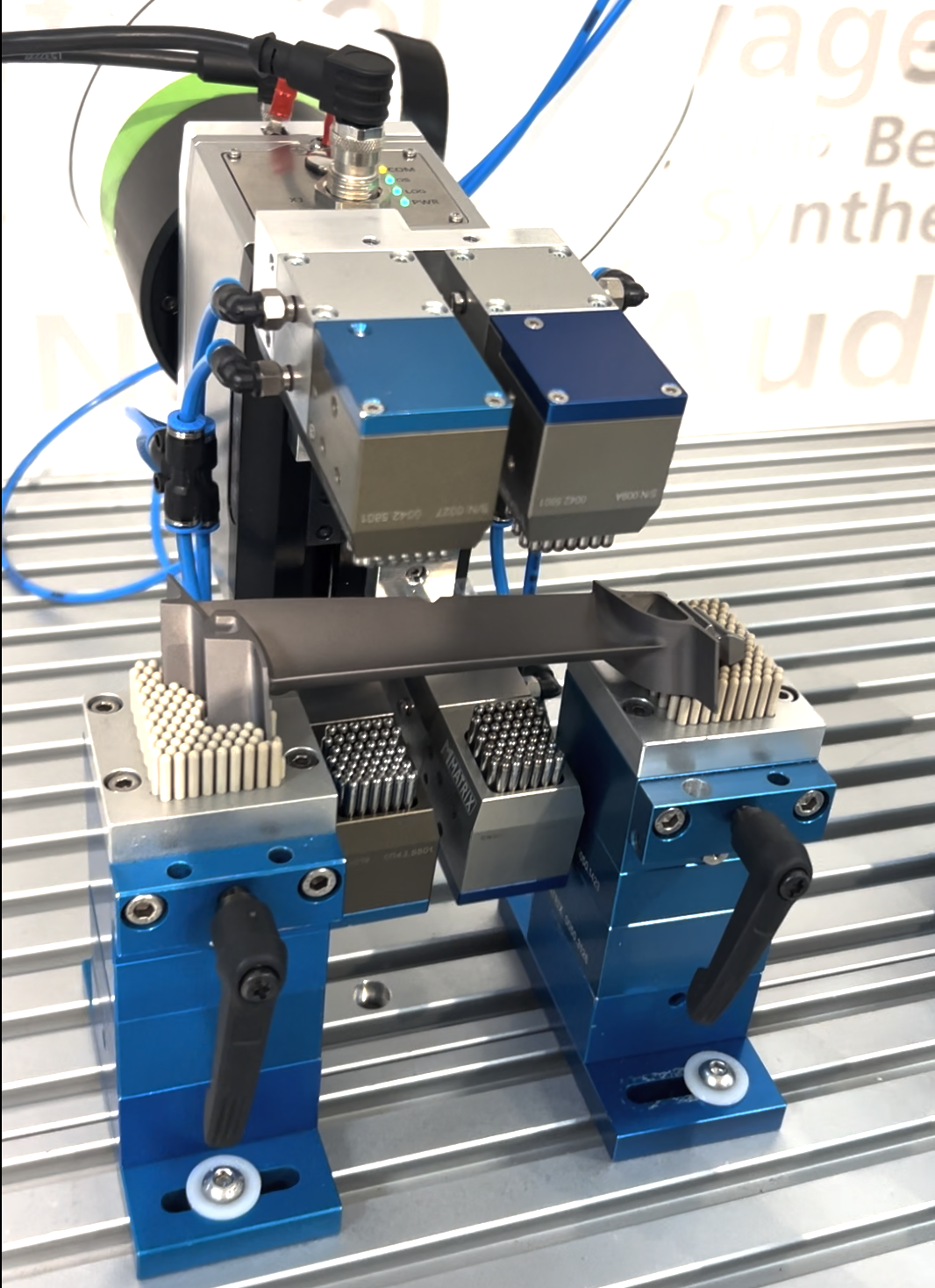
FlexCLAMP consists of numerous spring-loaded MATRIX pins that move against the component when the clamping system closes.
The pins conform to the actual contour of the airfoil or root and form a negative impression of the geometry.
Subsequently, the pins are pneumatically clamped, so that the set form is stored and gripping or clamping force can be safely transmitted.
A pressure-free locking mechanism ensures that fixation is maintained even in case of compressed air failure.
This transforms a single clamping system into a universal blade fixture that can safely and gently accommodate:
- different airfoils
- various fir-tree profiles
- intermediate states in the manufacturing process
without mechanical changeover.
Application in Automated Measurement Processes
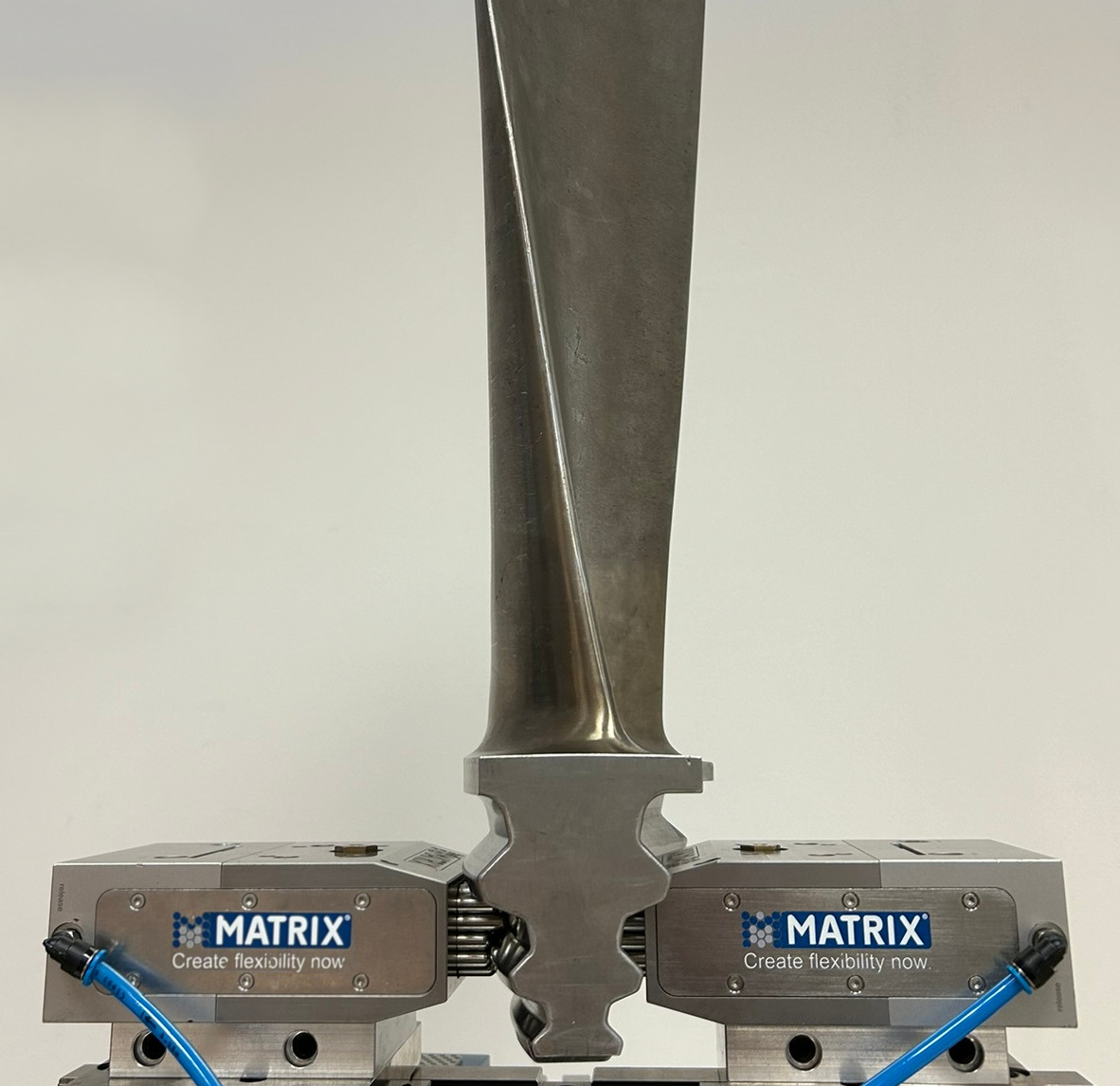
In a customer application, a robot grips various turbine blade types from a fixture and transfers them to a measurement cell. There, the blades must be securely fixed for the automated measurement sequence.
FlexCLAMP can be used as:
- an end effector on the robot gripper
- a flexible clamping device in the measurement cell with which the blade is fixed during measurement
The mechanism is the same in all applications:
The pin matrix replicates the actual geometry, is locked, and holds the component with form fit and repeatability – regardless of whether it's a blade, a medical device component, or any other freeform workpiece.
Advantages in Blade Handling
Several concrete advantages emerge in the measurement process:
One Clamping System for Many Variants
Blades of vastly different shapes can be gripped or fixed with the same FlexCLAMP.
Elimination of Specific Gripper Jaws
Design, manufacturing, and storage of diverse jaw sets are eliminated.
No More Gripper Warehouses
Instead of an entire "warehouse" of grippers or jaw variants, only one adaptive gripper is needed.
Reduced Changeover Times
Geometry changes occur on the software and process side, without mechanical changeover.
Gentle Force Transmission
The pin surfaces distribute forces, better protecting sensitive airfoils and coatings
This transforms workpiece handling from a bottleneck into a scalable resource: New blade types no longer require new gripper hardware – they are simply integrated into the existing system.
Alternative Measurement Fixture: Positioning Turbine Blades on the MATRIX FLEXSTATION®
In addition to FlexCLAMP for gripping and clamping, there is a second option for flexibly fixing turbine blades in the measurement process: the MATRIX FLEXSTATION.
Here, the focus is not on the gripper, but on the measurement fixture itself.
Traditional Measurement Fixtures for Horizontal Measurement
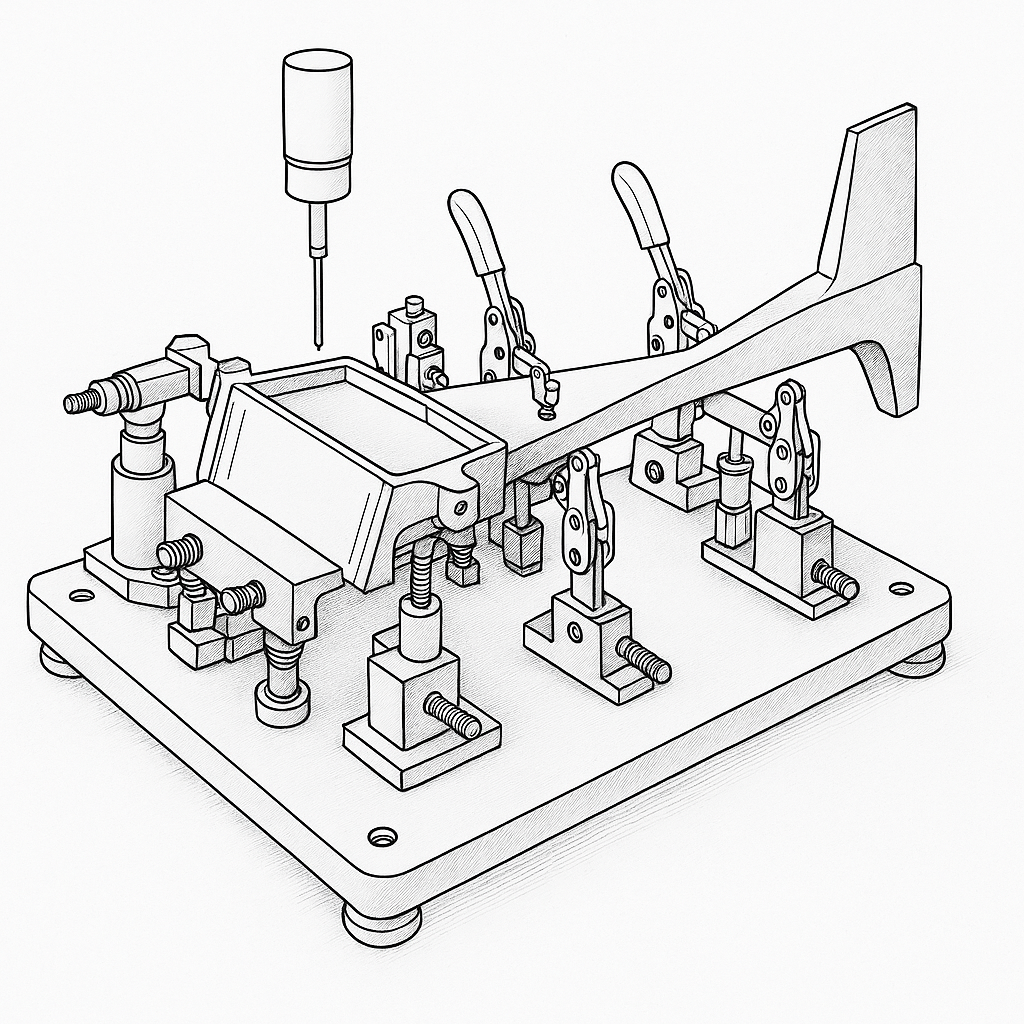
For tactile measurements (e.g., on coordinate measuring machines), blades are often placed horizontally and positioned via defined support and clamping points. Traditionally, this means:
- Component-specific measurement fixtures
- Fixed support prisms or form inserts
- Complex adaption for every geometry change
- High inspection tool variety and storage requirements
Here too: Every new blade variant leads to new measurement fixtures - with corresponding effort.
CAD-Controlled Measurement Fixture with FLEXSTATION
The FLEXSTATION replaces rigid measurement fixtures with a programmable pin platform that is configured based on CAD data:
- CAD models of the blade (e.g., STEP, IGES, DXF) are loaded into the FLEXSTATION software.
- The system recognizes the relevant geometry and calculates a suitable fixture.
- The pins automatically move to the calculated position and are locked.
- A contour-adapted pin nest is created on which the blade can be horizontally positioned for measurement.
The measurement fixture thus becomes a digitally configurable fixture device:
- no design adaptation required for variant changes
- Reproducible, repeatable position fixation
- One system for different blade types and sizes
Benefits of FLEXSTATION in Blade Metrology
For measurement cells and quality assurance areas, this results in:
Fewer Component-Specific Measurement Fixtures
A programmable system instead of many individual fixtures.
Faster Introduction of New Geometries
New blade types are taught via CAD, not through mechanical redesign.
Consistent Measurement Conditions
The pin support replicates the actual blade contour and compensates for manufacturing tolerances, keeping the measurement process stable.
Reduced Floor Space and Storage Requirements
Eliminated measurement fixtures reduce inspection tool storage and simplify organization
The FLEXSTATION thus complements FlexCLAMP ideally: While FlexCLAMP makes gripping and clamping in automated processes more flexible, FLEXSTATION makes the measurement fixture itself variant-capable.
Conclusion: A Modular System for Variant-Capable Turbine Blade Measurement Processes
The combination of MATRIX FlexCLAMP and MATRIX FLEXSTATION addresses the central challenge in turbine blade metrology:
- High variant diversity
- Complex freeform geometries
- Strict quality requirements
- Limited resources for fixture design and changeover
FlexCLAMP reduces workpiece handling effort – including the elimination of entire gripper warehouses – and enables safe, component-friendly clamping of diverse blade types with a single system.
Die FLEXSTATION makes measurement fixtures programmable and ensures that the measurement process can respond flexibly to new geometries without building new fixtures.
For companies, this means:
- Fewer inspection and clamping tools
- Lower changeover and engineering efforts
- Higher variant capability in manufacturing and quality inspection
- A clearer perspective on future blade generations – without a fixture jungle
.svg)

.png "Footer Shadow")