
.svg)
.svg)


.png)
.png)

.svg)
.svg)
Flexible robotic grippers for changing workpieces — Adaptive gripping solutions with MATRIX FLEXCLAMP
In many manufacturing plants, automation is no longer the biggest hurdle — it is a wide range of variants. High-mix/low-volume, short product life cycles and frequent geometry updates present production systems with the challenge of reliably handling a wide variety of parts.
Especially in assembly and testing processes, the gripper therefore often becomes a limiting factor: The robot is there, the handling principle is clear — but as soon as the component changes, new gripper fingers, new jaws or even a completely new gripper are needed.
Challenge: Grippers scale poorly in cells with many variants
Many automation cells follow a well-known pattern:
- Each component variant has its own gripper jaws or gripper fingers
- When changing products, there is a mechanical conversion (or the robot changes the entire gripper)
- Grippers and jaw sets must be stored, managed, cleaned and recovered
- In addition, cycle time risks arise due to retooling, incorrect assembly or unclean gripping positions
This scales poorly: More variants not only mean more programming, but above all more hardware, more downtime and more complexity in operation. This is exactly a typical problem in high-mix/low-volume environments, where classic automation quickly reaches its limits.
The next step: from component-specific gripper to adaptive gripping surface
Quick-change systems and modular grippers help, but often remain component-specific: In the end, a mold still has to be designed — just as a set of gripper fingers instead of as a complete gripper.
The logical next step is a gripping solution that adapts to the real workpiece geometry and then stably locks this shape. This is exactly where that goes MATRIX FLEXCLAMP system on.
Solution: MATRIX FLEXCLAMP — adaptive pins, flexible outline, secure locking
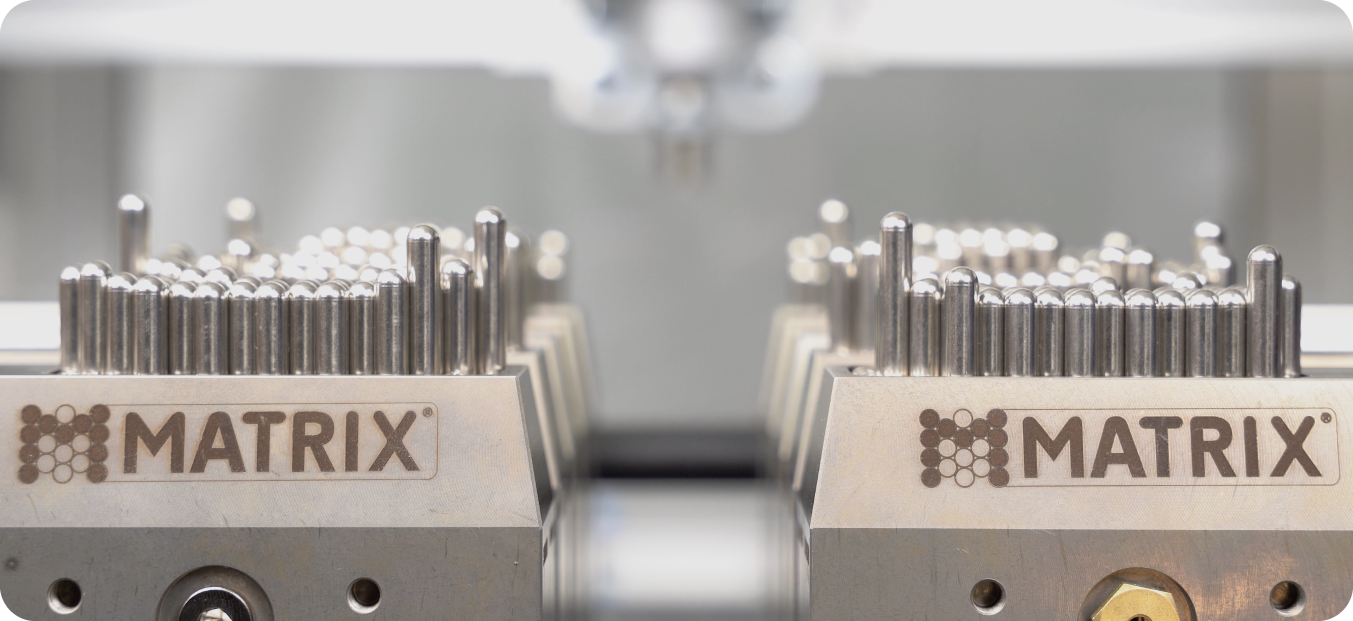
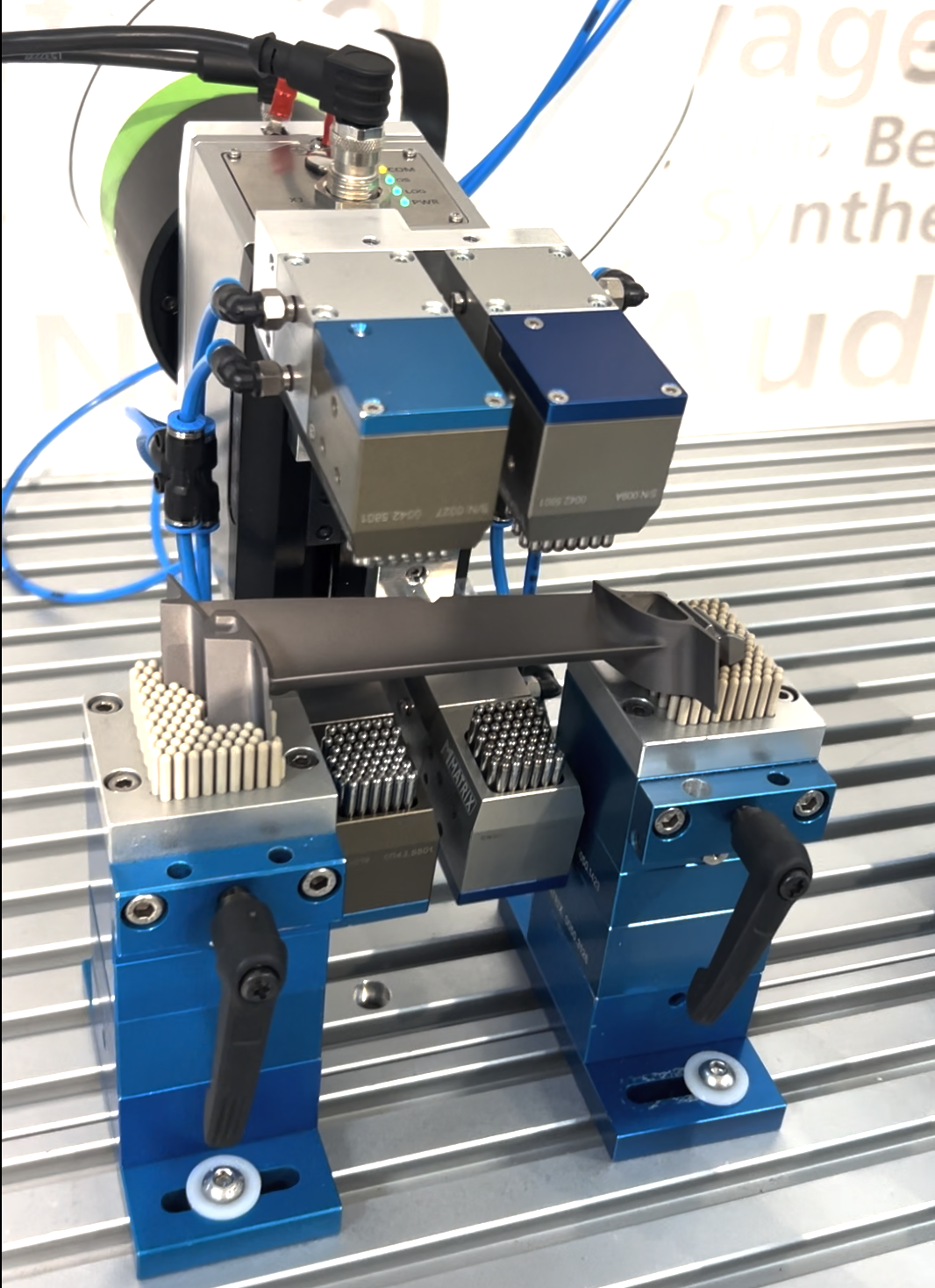
The FLEX-CLAMP system from MATRIX can be mounted both as an end effector on robot grippers and used as a flexible support. It consists of a variety of spring-loaded matrix pins, which adapt to the workpiece geometry when the gripper is closed. After adjustment, the pins are pneumatically clamped to save the negative shape and apply gripping force.
A special feature is the pressureless lock, which ensures secure fixation even in the event of compressed air failure. In addition, the system can significantly reduce or replace gripper changes and even gripper stations in diverse applications.
In short: Instead of “recreating” the geometry using gripper-specific jaws, the result is a adaptive contact and gripping surface, which forms, locks and ensures process reliability.
How the principle works in practice
The basic principle can be broken down into four steps:
- Start and shape
The gripper moves on the workpiece. When closed, the pins spring onto the contour and form a locally adaptable contact surface. - Lock and save shape
As soon as the pins are in contact, they are pneumatically clamped — the adjacent contour is “frozen”. - Apply gripping force and move
An additional gripping force supports the form fit. The workpiece can be transported, oriented or transferred to a subsequent operation. - Loosen and next workpiece
To remove it, the clamp is released with compressed air. The pins can return to a defined initial position and then reshape themselves to the next geometry.
Three typical gripping and handling scenarios for FLEXCLAMP
In practice, the biggest levers arise when you think gripping strategy and process layout together. Three common scenarios:
1) Two-sided gripping: two adaptive gripping surfaces instead of two sets of jaws
Two FLEXCLAMP units grip the component from two sides. Advantage: A gripper covers several geometries because each contact surface forms and locks. Ideal for complex outer contours, sensitive surfaces or changing component families.
2) One-sided grip + hold-down: shape-adjusted pick up from above
In some cells, two-way access is not possible (installation space, component position, cycle). Here, a FLEXCLAMP unit can shape and lock from above or from one side — an additional holder/swing clamp then takes over the actual holding force. This is particularly attractive when components lie on a support and need to be held securely.
3) Scaling across multiple units: large parts, great freedom
For large workpieces, the gripping surface can be scaled using several FLEXCLAMP units. In this way, even long or flat components can be stably picked up without the need to assemble a large, component-specific special gripper. At the same time, the layout remains modular: the number and position of the units are based on the component and the process.
What companies gain with it
The benefits are usually not reflected in a single KPI, but in the sum of many reliefs:
- Less gripper hardware: An adaptive system can cover several variants instead of requiring many sets of jaws.
- Less downtime: Gripper changes and conversion processes are omitted or significantly reduced.
- Faster product changes: In many cases, new geometries can be handled without mechanical adjustment.
- Less layout effort: Tool change stations and gripper stations can become smaller or be omitted.
- Gentle contact: Pins attach themselves instead of creating hard load peaks at certain points — particularly interesting for sensitive surfaces.
When FLEXCLAMP is particularly useful
FLEXCLAMP shows its strengths when:
- Many variants run on one line (or variants are added regularly)
- Components have a high tolerance (castings, forged parts)
- classic gripper fingers must be reworked frequently
- Product changes require rapid handling adjustments
- The gripper change is a recurring reason for downtime
Conclusion: The gripper becomes a flexible process component — not a variant warehouse
In diverse production environments, it is often not robotics that determines profitability, but handling. Adaptive gripping solutions such as MATRIX FLEXCLAMP are shifting the focus: away from component-specific gripper jaws towards a gripping surface that adapts, locks and grips reliably.
If you are currently struggling with frequent gripper changes, variant hardware or unstable gripping positions, it's worth taking a look at adaptive gripping strategies — before ordering the next set of gripper fingers.
.svg)

.png "Footer Shadow")